Open: OER and AI
Tensions Between OER and AI
It may feel like we have been talking about generative artificial intelligence for decades, and maybe you have, but in terms of regulations of AI, we have just gotten started! At the nexus of AI and Open Educational Resources (OER), there are still many legal and ethical considerations. As a starting point, Andrea Willige:
“The advent of generative AI is proving a stress test to its philosophy of the open sharing of creative work. Large Language Models harvest public content at scale, often stripping out any reference to the original creator and ignoring their wish to share their work reciprocally.” (2025)
As Andrea points out, there are some serious points of friction between AI and OER. When openly accessible materials are used to train AI, many are stripped of their copyrights, and when used in LLM responses, they often lack their required attribution. In response to this, Creative Commons has created CC Signals, which attempt to dictate how an author wants their material to be used to train AI. It will be interesting to see if there is interest in or awareness of CC Signals. This issue is compounded by the environmental, pedagogical, and ethical considerations that have been a part of the AI conversation for many years.
If authors are still interested in using AI for OER creation, there is also a murky zone of current regulations that dictates copyright can only be attributed to human created material. One possible interpretation of this can be material produced by AI must be substantially altered by an author for it to fall under copyright.
Opportunities for Collaboration between OER and AI
Now that we’ve looked at the big tensions AI has brought in the open access spaces, let’s look at how some Open Access (OA) professionals are using AI to support their work. Lance Eaton provides us with some options:
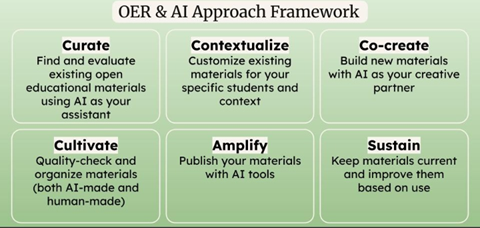
These six approaches demonstrate the ways that authors of OER can use AI to cocreate content, with an emphasis on the need to heavily edit and improve AI created content. As Lance points out, AI can be used throughout OER development from formatting, content creation, to editing.
Any major use of AI, especially content creation, should be clearly stated by the author. This can be an acknowledgement in specific sections where AI was used, or a statement at the beginning of your work listing where AI was used. There is not one established way to write this attribution, but tools like the AI Attribution Toolkit can be a useful option.
If you are looking for further support resources regarding OER and AI, CTLR and the Library many great resources including the following:
- GenAI in Teaching and Learning Resources: https://ctlr.vcc.ca/teaching-and-learning/gen-ai-in-teaching-and-learning/
- Generative AI Subject Guide: https://libguides.vcc.ca/genai
- OER and AI Subject Guide: https://libguides.vcc.ca/c.php?g=705616&p=5356420
References
AI Attribution Toolkit. (n.d.). https://aiattribution.github.io/
Creative Commons. (n.d.). CC Signals: A New Social Contract for the Age of AI. https://creativecommons.org/ai-and-the-commons/cc-signals/
Eaton, L. (2025, August 25). A Framework for using AI with OER. https://aiedusimplified.substack.com/p/a‑framework-for-using-ai-with-oer
Patrick Powers Library. (2025). Artificial Intelligence: Ethical Considerations. Saint Mary’s University. https://libguides.smu.ca/artificialintelligence/ethical
Willige, A. (2025). What is Creative Commons- and how is AI turning it on its head? World Economic Forum. https://www.weforum.org/stories/2025/10/what-is-creative-commons-and-how-is-ai-challenging-it/
Additional Resources:
Worksheet: Roles for AI in Instruction: https://docs.google.com/document/d/1L1o5oSv_GqTb0kH2ZdouF3wHRTPjibuZKDMvPCx4cK4/edit?tab=t.0#heading=h.kk1966kbedef
Video: Revising and Remixing with AI: Ethical and Practical Considerations: https://www.youtube.com/watch?v=L‑vX1OAwEqE&t=1s